Your Guide to U.S. SLP Programs as an International Student

Navigate admissions, prerequisites, online study, and visa requirements to launch your speech-language pathology career in the United States.

By Benjamin Thompson, M.S., CCC‑SLPReviewed by SLP Editoral TeamUpdated June 29, 202625+ min read
US SLP Programs for International Students: Admissions & Online Options

Points of interest…

  • Total expenses for a two-year US MSLP range from $45,000 to $80,000, with international students ineligible for federal aid.
  • Eastern New Mexico University (ENMU) offers an online MSLP at approximately $20,000, making it a cost-effective CAA-accredited option.
  • ASHA requires 400 clinical hours supervised by a US-licensed SLP, limiting online placements for students living abroad.
  • Fewer than 9% of US SLP graduate programs required the GRE in 2026, simplifying admissions for international applicants.

Introduction: Your Guide to US SLP Programs as an International Student

International speech pathology graduate students face an early choice: enroll in a program at home or abroad, or commit to a US-based master’s. A non-US degree can appear less expensive, but the added costs of credential evaluation, gap coursework, and a longer path to ASHA certification often level the field. With fewer than 9% of programs now requiring the GRE, the admissions door is wider than it has been in decades. The deciding factor remains accreditation: only a CAA-accredited program provides a predictable route to the CCC-SLP certification. The schools that genuinely welcome international students bake that clarity into their admissions handbook, clinical placement model, and licensure counseling from the start.

Caa-Accredited SLP Programs That Welcome International Students

A CAA-accredited program is one that has met the rigorous standards of the Council on Academic Accreditation in Audiology and Speech-Language Pathology , the body that ensures your graduate education meets U.S. certification and licensure requirements. For international students, finding CAA-accredited SLP programs that are genuinely international-friendly takes a bit of detective work, but a few reliable tools make the search straightforward.

Start with the ASHA EdFind Database

The American Speech-Language-Hearing Association's EdFind tool (asha.org/edfind) is the best starting point for building your shortlist. You can filter by delivery type , including online SLP programs, on-campus, and hybrid formats , and instantly see their accreditation status. While EdFind does not have a dedicated "international" filter, it gives you a clean, up-to-date list of every CAA-accredited graduate program in the country. Once you have that list, move to the next step: cross-checking with each program's own website.

Cross-Check with Program Websites

Visit the admissions or graduate program page for each school on your EdFind list. Look specifically for sections labeled "International Students," "Admissions," or "Future Graduate Students." What you want to spot are explicit statements about visa support, English proficiency waivers, or special enrollment pathways for non-U.S. applicants. Some programs proudly highlight their international student services or diversity statistics on a "Facts & Figures" page or in their graduate student handbook. If you see language like "we welcome international applicants" or "F-1 visa eligibility," that's a strong green flag. If the website is silent, email the graduate admissions office and ask directly.

Get the Numbers: Employment Outlook and International Enrollment

For a broad view of the profession, the Bureau of Labor Statistics (bls.gov) offers a reliable, big-picture employment outlook for speech-language pathologists that can help you weigh the long-term value of studying in the U.S. However, BLS data does not break down international student enrollment or job placement by program. To find how many international students a program typically admits , or what their outcomes look like , you'll need to go directly to the source. Graduate coordinators can often share recent demographic snapshots or point you toward anecdotal information. Student forums like GradCafe, Reddit's r/slpGradSchool, and NSSLHA chapter pages are also useful for gathering unscripted insights from current and former international students. Professional associations tied to your state of interest frequently host virtual open houses or maintain listservs where you can ask about programs with strong international support.

Ultimately, the most welcoming programs are those that spell out the international admissions pathway clearly, offer dedicated advising for visa processes, and have a track record, even if modest, of enrolling and graduating students from outside the U.S. Invest the time to verify accreditation and international readiness side by side, and you'll build a list of programs where you can thrive.

Questions to Ask Yourself

An office that specializes in F-1 regulations and clinical placement logistics can save months of confusion, and seeing past international graduates confirms the program knows how to support your path to licensure.

Advisors who routinely work with international transcripts can help you avoid repeated prerequisite challenges and ensure your prior coursework is recognized, so you don't lose time or credits.

If your bachelor's is in a different field, a built-in leveling track lets you complete prerequisites within the degree, skipping a separate and often expensive post-baccalaureate year.

English Proficiency Requirements at Top SLP Programs for International Applicants

A strong TOEFL iBT or IELTS score is essential for admission to US speech-language pathology graduate programs; the clinical nature of the field raises expectations for spoken and written English. In many programs, speaking and writing sub-scores carry as much weight as the overall total, because graduate clinicians must communicate precisely with clients, families, and supervising SLPs from day one.

Why Speaking and Listening Sub-Scores Matter More

SLP programs prepare you for client-facing work that demands flawless pronunciation, comprehension of rapid conversational English, and the ability to explain complex therapy techniques to caregivers. That is why some schools set higher bars for speaking and listening than for reading. The University of Washington MS in Speech-Language Pathology, for instance, requires a TOEFL speaking score of 26 and a listening score of 26, even though its overall minimum is 105. Texas State University MS in Communication Disorders, by contrast, does not publish separate sub-scores for TOEFL but asks for an IELTS minimum of 6.0 in each module. If your home institution offered coursework in English, you may be exempt from testing, but many SLP programs still require scores unless your bachelor’s degree was earned in a country where English is the primary language.

A Snapshot of Minimum Scores at 15+ Programs

The table below summarizes published English-proficiency cutoffs for a selection of CAA-accredited programs that admit international students. Scores are drawn from program admission pages, not third-party aggregators, and reflect the most recent cycles (2025, 2026). Where a field is blank, the program does not set a separate sub-score requirement or the information was not publicly available as of mid-2026.

ProgramTOEFL iBT Overall MinTOEFL Sub-Scores (if specified)IELTS Overall MinIELTS Sub-Scores (if specified)Additional Notes
University of Washington MS in Speech-Language Pathology105Speaking 26, Listening 267.5Speaking 7.5, Listening 7.5Does not accept MyBest superscores or Duolingo; TOEFL ITP Plus China not accepted.
Texas State University MS in Communication Disorders78,6.56.0 minimum in each moduleScores valid for two years; no conditional admission.
University of Texas at Austin MSSLHS79,6.5,Check department page for any section-specific advice; a 79 is the Graduate School minimum.1
DePaul University MS in Speech-Language Pathology96,7.0,Accepts Duolingo with minimum 125; application not reviewed if score threshold not met.2
West Virginia University Online MS in Speech-Language Pathology79,6.5,Also accepts PTE Academic 53 or Duolingo 105; exempt if degree earned in an English-speaking country.3
Northeastern University MS in Speech-Language Pathology100,,,Admissions page lists 100 as the TOEFL requirement; IELTS details should be verified directly.4
Saint Louis University MS in Speech-Language PathologyCheck program page for current overall minimumSection score requirements suspended as of Fall 2026,,Only the overall TOEFL score is considered; section requirements were removed starting Fall 2026.5
University of Minnesota MA in Speech-Language PathologyTOEFL required (no published minimum),TOEFL or IELTS required; exam must be within 2 years,No interview; scores are reviewed holistically; competitive applicants typically present strong speaking/writing subs.6

Other CAA-accredited programs that routinely accept international students, such as University of Northern Colorado, University of Texas at Dallas, University of Arizona, University of South Florida, California State University Northridge, University of Florida, and Nova Southeastern University, typically set TOEFL minimums between 80 and 100 and IELTS minimums of 6.5 or 7.0. Many of these schools also look for speaking and writing scores above 22 on TOEFL, or equivalent IELTS band scores of 6.5 or higher. Because exact cutoffs change year to year, always confirm directly with the program’s graduate admissions office.

Beyond the Numbers: Interviews, EAP Courses, and Alternative Tests

A handful of programs supplement test scores with a required oral interview, especially if your TOEFL speaking sub-score is borderline. In such cases, the interview becomes a crucial part of the admission decision. Some universities also offer conditional admission: you are accepted on the condition that you complete an English for Academic Purposes (EAP) course during your first term, before the clinical practicum begins. West Virginia University, for example, provides a clear exemption path for applicants whose previous degrees were taught entirely in English, while DePaul University accepts the Duolingo English Test as an alternative. As you compare programs, pay attention not just to the scores but to the full policy - whether superscored tests are accepted, if expiration dates apply, and whether you might need a summer intensive English course. This level of detail can make the difference between a smooth application and an unexpected hurdle.
How to Evaluate Your Foreign Credentials for US SLP Admissions

Why Credential Evaluation Matters

US graduate programs in speech-language pathology need to understand how your previous education compares to a US bachelor's degree. A professional credential evaluation translates your transcripts, diplomas, and coursework into terms American admissions committees can read. This step is not optional for most international applicants; it establishes whether you meet the academic foundation required to begin clinical graduate study.

Choosing a Recognized Service

The Council for Higher Education Accreditation (CHEA) and many SLP programs recommend members of the National Association of Credential Evaluation Services (NACES). Two names you will encounter most often are World Education Services (WES) and Educational Credential Evaluators (ECE). Both offer course‑by‑course reports that detail each class you took, the US credit equivalent, and the grade equivalent. This level of detail matters because communication sciences and disorders programs need to see if you have covered specific prerequisite topics, not just a diploma equivalency.

The Step‑by‑Step Process

  • Gather documents: Request official transcripts from all postsecondary institutions you attended. If they are not in English, you will need certified translations.
  • Choose a report type: Select a course‑by‑course evaluation. A general evaluation is not enough for graduate admissions.
  • Submit and pay: Create an account with WES or ECE, enter your educational history, and pay the required fee. Fees typically start around $200 to $250 for a course‑by‑course report.
  • Designate recipients: During the application, you can list the SLP programs that should receive your evaluation. Services can send reports electronically or by mail directly to the institutions you select.
  • Track completion: Once all transcripts arrive, evaluations usually take several business days. Monitor your account and confirm the report reached each program.

Matching Prerequisites and Filling Gaps

When the report arrives, programs will check for the undergraduate communication sciences and disorders coursework expected before graduate study. Common SLP prerequisites include anatomy and physiology of speech, phonetics, language development, audiology, and articulation disorders. If your foreign degree did not include these, do not panic. Many US SLP programs allow you to complete levelling courses before or during the graduate semester. These prerequisite classes are available online through several universities, and your evaluation will show exactly which ones you need.

Program‑Specific Requirements

Not all SLP programs use the same evaluation process. Some accept credential evaluations only from ECE; others require a specific course‑by‑course report with GPA calculation. Before spending money, always check the international admissions page of each program you are considering. The program may also ask you to submit a detailed syllabus for certain courses to determine equivalency. Reaching out to the graduate coordinator with your evaluation in hand can smooth the process and help you plan any levelling work.

If you're an F-1 visa holder in a speech-language pathology master's program, you're eligible for up to 12 months of post-completion Optional Practical Training (OPT)2, but the field does not qualify for the 24-month STEM extension2. That makes early planning for Curricular Practical Training (CPT) and your clinical fellowship timeline essential.

From I-20 to Visa Interview: A Quick Timeline

After you accept admission, your program's Designated School Official (DSO) issues the Form I-20. Pay the SEVIS I-901 fee online, then complete the DS-160 visa application and schedule your interview at a U.S. embassy or consulate. Once approved, you may enter the U.S. up to 30 days before the program start date shown on your I-20. Upon arrival, report to your DSO in person and register for full-time enrollment1; ASHA-accredited master's programs typically require 9, 10 credits per term to maintain status.

Curricular Practical Training (CPT) for Off-Campus Clinical Practicums

SLP graduate programs require supervised clinical hours, and many use off-campus placements that function as a speech pathology internship and count toward CCC-SLP certification hours. CPT authorization allows you to work legally in those settings, but you must meet specific rules:

  • Eligibility timeline: F-1 regulations require one full academic year of full-time enrollment before CPT begins.1
  • Curricular requirement: The placement must be a required or integral part of your graduate curriculum.1 Clinical practicums that count toward ASHA certification hours generally meet this standard.
  • Hours and limits: Part-time CPT is defined as 20 hours per week or fewer1; full-time CPT is anything above 20 hours per week. If you accumulate 12 months or more of full-time CPT, you lose eligibility for OPT at the same degree level1, so coordinate with your DSO to preserve post-graduation work authorization.
  • Authorization: You need CPT authorization on your I-20 for each practicum site before you start working. Your DSO updates your SEVIS record and prints a new I-20 with the employer and dates.1

Optional Practical Training (OPT) and the Clinical Fellowship Year

After completing your master's coursework, you can apply for post-completion OPT to work as a clinical fellow. Because SLP master's programs are not STEM-designated, you won't be eligible for the 24-month STEM extension.2

  • Application window: USCIS accepts OPT applications from 90 days before your program end date until 60 days after. Processing delays are common, so we recommend applying early.1
  • Employment and unemployment: Your OPT employment must be directly related to your degree, and you cannot accumulate more than 90 days of unemployment during the 12-month period.1 Securing a clinical fellowship position quickly is critical.
  • Grace period: After OPT ends, you have a 60-day grace period to depart the U.S., transfer to another program, or change status. Plan for your clinical fellowship to finish within your OPT validity window.1

Many international graduates complete their clinical fellowship during the OPT year, then transition to an H-1B visa if an employer sponsors them. Speech-language pathology qualifies as a specialty occupation under H-1B rules3, but sponsorship is never guaranteed. Start conversations with potential clinical fellowship employers early to explore your options.

Maintaining Status With Your Designated School Official

Keeping lawful F-1 status while juggling clinical hours is a moving target. Your DSO is your best resource for:

  • Confirming full-time enrollment counts when clinical practicums replace on-campus credits.
  • Verifying CPT site authorizations and preventing unintentional unauthorized employment.
  • Extending your I-20 if your program takes longer than the end date originally listed.
  • Navigating SEVIS reporting and travel signatures during clinical off-sites.

Reach out to your program's DSO at least once per term to review your plan and keep your SEVIS record active throughout the clinical training portion of your degree.

In 2026, fewer than 9% of U.S. speech-language pathology graduate programs required the GRE, down from more than half in the early 2010s. This shift removes a major barrier for international applicants, and ASHA’s latest demographic data indicate that the number of internationally educated SLPs has been steadily climbing.

Worth Noting

Plan for $45,000 to $80,000 in total expenses for a two-year MSLP program, including tuition, fees, health insurance, and living costs. International students are usually ineligible for U.S. federal aid, so scholarships and assistantships are critical. Online programs can reduce living costs, and some public universities charge lower tuition than private ones.

Clinical Placement Options for Online SLP Students Living Abroad

The Clinical Puzzle for Online Learners

Online SLP programs deliver coursework to your laptop anywhere with a good internet connection. The harder piece is the clinical practicum: ASHA requires 400 supervised hours5, and those hours must be earned under an ASHA-certified speech-language pathologist. For students living outside the United States, finding a placement that checks all the boxes, without relocating, is the single biggest hurdle in the entire degree.

Three Common Placement Models

Programs generally fall into one of three camps, sometimes blending elements from each.

  • Home-country partnerships: A handful of programs have built reciprocal relationships with clinics, hospitals, or schools in other countries. The program helps arrange a site near you that can meet ASHA supervision standards. Ithaca College, for instance, includes clinical placement services with its fully online MS; you work with a coordinator to identify a viable local setting.1
  • On-campus intensive blocks: Some online programs ask students to travel to the U.S. for concentrated in-person sessions. Pepperdine University requires three in-person immersions2, and Pennsylvania Western University includes a one-week on-campus intensive3. These blocks compress hands-on practice, simulation, and supervised client contact into short, structured visits.
  • Hybrid relocation: A smaller number of programs are structured so that the beginning is online but you must relocate to the States for the final semesters of clinical work. This model essentially treats you like a domestic student for the practicum phase.

What International Applicants Should Verify

Not every online program that is “international-student-friendly” handles placements the same way. Directly ask: Does the program arrange a site in my home country, or do I need to travel to the U.S. for intensives? Will my supervisor be ASHA-certified, and what documentation is required to map competencies? Programs like Baylor University (which accepts TOEFL/IELTS and places students close to home)4 and affordable options such as Eastern New Mexico University (ENMU) or the University of Nebraska Kearney often appear in international-applicant discussions. But each program’s placement model must be confirmed case by case, especially for students living abroad full-time.

Visa and Supervision Rules

A fully online program does not make you eligible for an F-1 student visa while you remain overseas.7 If your program includes a brief on-campus intensive, you may be able to attend on a B-2 visitor visa, but immigration law is nuanced: clinical practicum can be viewed as “work,” and a B-2 generally does not permit employment.7 Always consult the program’s international student advisor and, ideally, an immigration attorney before booking a flight. International placements, when done well, rely on reciprocal, ethical partnerships rather than voluntourism, and they require detailed competency mapping, supervision logs, and reflective assessment to satisfy ASHA.6

Your Path to ASHA Certification as an International Graduate

Earning ASHA's Certificate of Clinical Competence in Speech-Language Pathology (CCC-SLP) is a clearly defined process, and as a graduate of a CAA-accredited program, your journey is streamlined. The certification is nationally recognized and is often a prerequisite for state licensure. Here's how to navigate the final steps toward becoming a fully credentialed SLP in the United States.

Pass the Praxis Exam in Speech-Language Pathology

Your first major milestone after graduation is the Praxis exam (code 5331). This standardized test assesses your knowledge across the SLP scope of practice. Most students take it during their final semester or shortly after completing their master's. A passing score, as set by ASHA, is required for both certification and many state licenses. Preparation resources are widely available, and many CAA programs integrate review into the curriculum.

Complete the Clinical Fellowship

Next, you'll embark on a Clinical Fellowship (CF): a mentored professional experience that lasts 36 weeks (or about 1,260 hours) under the supervision of an ASHA-certified SLP. The CF allows you to transition from academic learning to independent practice while receiving structured feedback. You must hold a temporary state license or clinical intern credential during this time, which your employer typically helps arrange. Many international graduates on Optional Practical Training (OPT) complete their CF year on an F-1 visa extension, provided the site qualifies.

Apply for State Licensure and ASHA Certification

Once your CF is successfully completed and your supervisor submits the required reports, you can apply for the CCC-SLP through ASHA and for a full state license. ASHA certification requires a completed CF, a passing Praxis score, and an official transcript from your CAA-accredited program. State licensure boards have their own applications, fees, and sometimes additional exams (like a jurisprudence test). Because ASHA certification is widely accepted, having the CCC-SLP can simplify multi-state licensure or moving between states later.

International Graduates: Streamlined with a CAA Degree

If you hold a degree from a CAA-accredited program, you will not need to complete a separate international credentials evaluation through ASHA's Mutual Recognition Agreement or other pathways. The CAA accreditation ensures your coursework and clinical hours meet the required standards, so you follow the same path as U.S.-trained graduates. This is a significant advantage, saving both time and money. Always verify specific state requirements, as some boards may request additional documentation, but the core process remains straightforward.

Frequently Asked Questions About US SLP Programs for International Students

Here are answers to the most common questions international students ask about pursuing a master's in speech-language pathology in the United States, from costs and visas to clinical placements and career outlook. We've based these on current program policies and ASHA guidelines.

Will SLP be replaced by AI?
AI is unlikely to replace speech-language pathologists. The field demands nuanced clinical judgment, empathy, and cultural awareness that technology cannot replicate. AI tools may streamline documentation and assist with exercises, but the human connection and diagnostic reasoning core to therapy remain essential. ASHA views AI as a supplement, not a substitute.
Can I enter a US SLP master's program without a communication disorders degree?
Yes, many CAA-accredited programs accept students from non-CSD backgrounds and offer prerequisite courses. These leveling courses cover phonetics, language development, and anatomy. You can complete them before applying or during the first year of the master's program. International applicants should verify that their undergraduate coursework meets the program's equivalency requirements.
What is the total cost for international SLP students in the US?
Total costs range widely. Some online programs, like ENMU, charge approximately $20,000 in total tuition. On-campus programs can cost $40,000 to over $100,000 including living expenses. International students must also budget for visa fees, health insurance, and foreign credential evaluations. Check each program's latest figures, as expenses change annually.
How do I get a student visa for SLP graduate programs?
After acceptance, your school will issue a Form I-20. You then apply for an F-1 visa at a U.S. embassy, providing proof of sufficient funds, English proficiency, and ties to your home country. For clinical practicums, Curricular Practical Training (CPT) authorization may be required. Start the process several months before your program begins.
What are the clinical placement options for international SLP students?
Placements are typically arranged by your program within the United States. Online programs may occasionally allow placements near your home country, but supervision must be provided by an ASHA-certified SLP. Due to this requirement, fully remote international placements are uncommon. Confirm specific clinical policies with your program before enrolling.
Which SLP schools accept international students?
Numerous CAA-accredited programs welcome international applicants. Examples include Eastern New Mexico University (online, around $20,000 total) and the University of Nebraska Kearney. Admissions policies differ, so review each school's international admissions page. Prioritize programs that clearly state they issue I-20s and support F-1 students.
Can I work during my SLP program on an F-1 visa?
Yes, F-1 students may work on campus up to 20 hours per week during academic terms. Off-campus work is limited but possible through CPT for required clinical practicums or Optional Practical Training (OPT) after graduation. Always consult your designated school official before accepting any employment to maintain your visa status.

Comprehensive Directory of Caa-Accredited SLP Programs Accepting International Students

This directory collects every CAA-accredited speech pathology master's degree program that publicly welcomes international applicants, based on a review of program materials and a recent guide to online SLP programs. While we aimed for completeness, international admissions policies can shift without notice, and not all programs actively promote this information. We encourage you to treat this list as a starting point for choosing the right SLP graduate program and to follow up directly with schools.

Online and Hybrid Programs with International-Friendly Policies

The programs below offer CAA-accredited online or hybrid formats and have confirmed international student acceptance as of early 2026. For each, visit the program’s website or contact admissions directly for the latest international application requirements, visa support, and clinical placement details.

  • Baylor University (TX): MS in Speech-Language Pathology, online with clinical requirements. International applicants should review the program’s dedicated international admissions page for visa and prerequisite guidelines.
  • Calvin University (MI): MA in Speech-Language Pathology, online with local clinical placements. The university provides international student services and issues I-20s for full-time online study with on-ground clinicals.
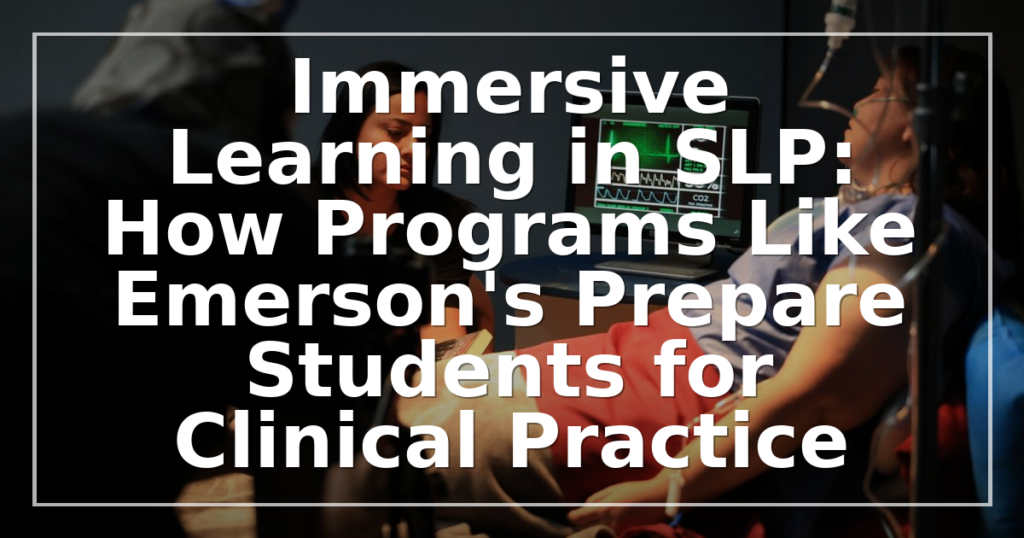
  • Emerson College (MA): MS in Speech-Language Pathology, online with required in-person clinical intensives. Emerson has a robust international student office and routinely enrolls students on F-1 visas for the online program.
  • James Madison University (VA): MS in Speech-Language Pathology, online with in-person clinical placements. The program’s three-year structure allows international students to maintain visa compliance while completing practicums.
  • NYU Steinhardt (NY): MS in Communicative Sciences and Disorders, online coursework plus in-person clinical placements at sites approved by the program. NYU’s Office of Global Services assists with I-20 issuance and CPT authorization.
  • Pepperdine University (CA): MS in Speech-Language Pathology, online with limited onsite immersions (CAA candidacy status). International students must confirm visa eligibility with the international student services office, as the hybrid model may affect full-time enrollment requirements.
  • University of Northern Colorado (CO): MA in Speech-Language Pathology, a three-year online track with clinical placements arranged near the student’s location. International applicants living outside the U.S. should verify telehealth and placement feasibility with the program.
  • University of St. Augustine for Health Sciences (TX, CA): MS in Speech-Language Pathology, online with required clinical placements at affiliated sites across multiple campuses. International students should confirm visa eligibility for the two-year program.
  • Yeshiva University Katz School (NY): MS in Speech-Language Pathology, primarily on-campus with online components (varies by track). The program may offer hybrid flexibility, but international students should verify full-time on-campus requirements for F-1 status.

On-Campus Options and Expanding Your Search

Beyond online programs, the majority of the 300+1 CAA-accredited SLP master’s programs are on-campus, and many actively enroll international students. Because no single comprehensive directory of international-friendly programs exists2, we recommend visiting the ASHA EdFind tool (edfind.asha.org) to filter programs by state, degree, and accreditation, then contacting admissions offices directly to confirm whether they accept international applicants and issue the required I-20 form.

A Word of Caution

International admissions policies, tuition structures, and clinical placement guarantees can change from one cohort to the next. Always verify the following directly with the program before committing to an application: that they issue F-1 student visas for the program, that your foreign degree evaluation will meet prerequisite requirements, and that clinical placements are available for students on a visa. The programs listed here represent those we could confirm as of early 2026, but your own outreach is the most reliable step.

Recent News

Recent Articles